 DriveAdria
Driving in Croatia: Tolls, Parking, Ferries and Speed Limits (2027 Guide)
Driving in Croatia is easy: modern toll motorways, good signs in English and Croatian, and a coast road with some of the best views in Europe. What catches visitors out are the details – a €260 camera fine near Dubrovnik’s Old Town, parking zones that only take an app or SMS, and ferries that fill up in summer. Here is what you need to know before you pick up the car.
What are the speed limits in Croatia?
In towns the limit is 50 km/h unless signs say otherwise, on open roads 90 km/h, on expressways 110 km/h and on motorways 130 km/h. There are no separate limits for young drivers, but fines rise quickly: in town, 20 km/h too fast already costs €130.
| Road | Limit |
|---|---|
| Built-up areas | 50 km/h (up to 80 where signed) |
| Open roads | 90 km/h |
| Expressways (brza cesta) | 110 km/h |
| Motorways (autocesta) | 130 km/h |
| Speeding in town | Fine | Speeding outside town | Fine |
|---|---|---|---|
| 10–20 km/h over | €60 | 10–30 km/h over | €60 |
| 20–30 km/h over | €130 | 30–50 km/h over | €260 |
| 30–50 km/h over | €390–920 | More than 50 km/h over | €660–1,990 |
With a trailer or caravan the limits are 80 km/h on open roads and 90 km/h on motorways. Limits and fines are from Croatia’s road traffic safety law, checked in November 2026. Higher fines are being discussed in 2026 but were not yet law at the time of writing.
What do you need in the car?
- Your driving licence and passport or ID card. An International Driving Permit is needed if your licence isn’t in the Latin alphabet – see what documents you need.
- The rental agreement and the car’s registration papers – the rental company gives you both.
- A warning triangle, a reflective vest, a first-aid kit and spare bulbs. A rental car already has them; check where they are before you leave.
If you stop on the carriageway because of a breakdown or an accident, you must wear the reflective vest when you get out, and on motorways and expressways put the triangle behind the car.
What are the main rules?
- Headlights: dipped headlights or daytime running lights are compulsory from 1 November to 31 March, day and night.
- Alcohol: the limit is 0.5‰. Drivers under 24 with a Croatian licence must have none at all, and fines start at €390 above 0.5‰ – the simple rule is not to drink and drive.
- Phone: hands-free only; holding the phone costs €130.
- Seat belts and children: everyone wears a belt. Children under 150 cm need a child seat or booster, and a rear-facing seat must never face an active airbag.
- Red light: no right turn on red. You may only turn when a separate green arrow is lit.
- Winter: from 15 November to 15 April, winter tyres – or summer tyres with at least 4 mm of tread plus chains – are compulsory on signed winter sections, mostly inland (Lika, Gorski kotar). On any road with snow or ice, a car without winter equipment may not be driven.
How do motorway tolls work in Croatia?
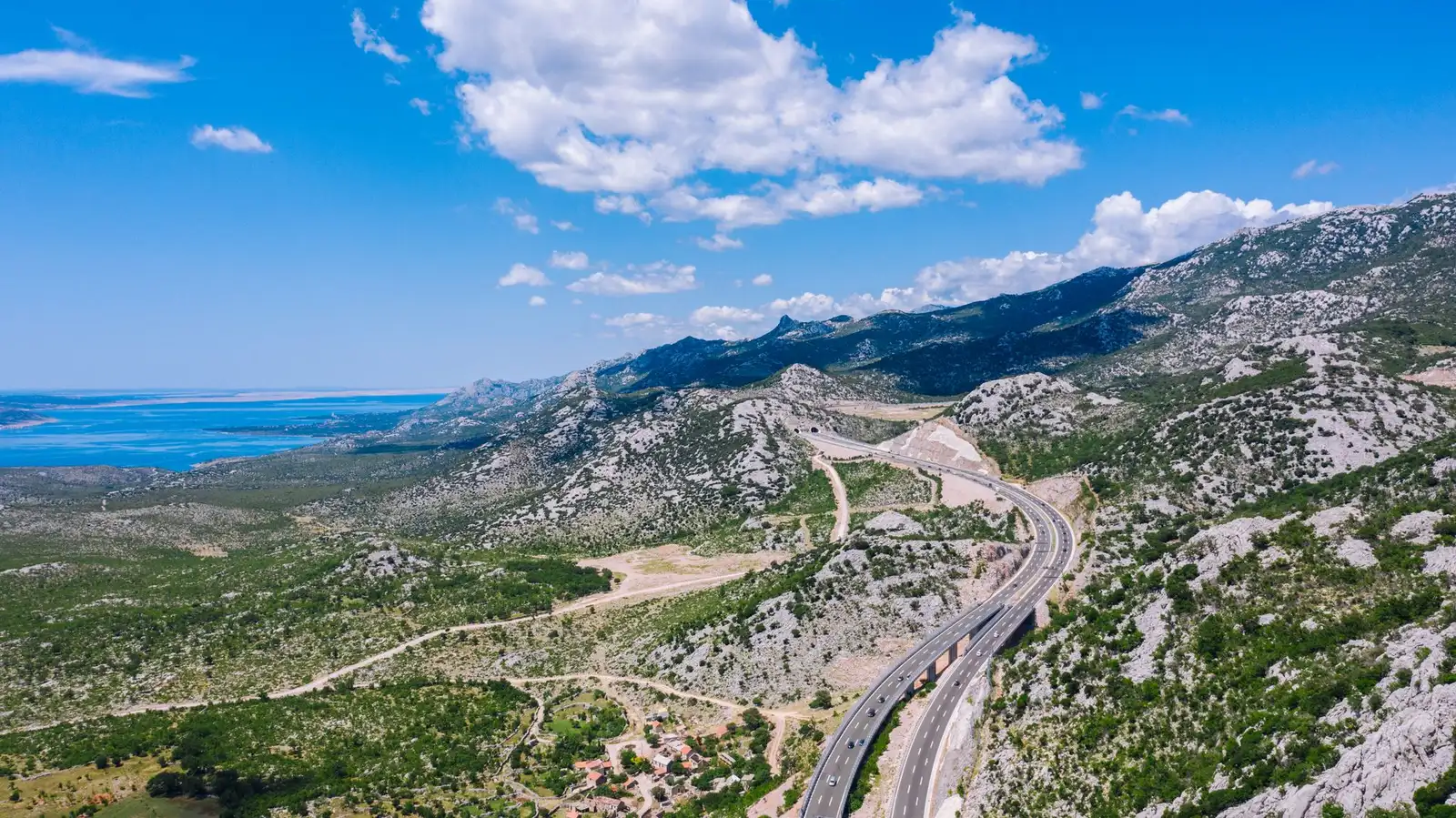
Croatia has no vignette – you pay per section. Today you take a ticket when you join the motorway and pay at the exit booth by card or cash. From 1 March 2027 Croatia plans to switch to barrier-free tolling with cameras instead of booths; how visitors and rental cars will pay had not been published yet in November 2026, and we will update this guide when it is.
| Route | Toll for a car |
|---|---|
| Zagreb – Split (Dugopolje) | €26.40 |
| Zagreb – Zadar | €17.60–18.20 |
| Zadar – Split | €8.10–8.70 |
| Split – end of the motorway near Ploče (towards Dubrovnik) | €7.30–7.40 |
| Zagreb – Rijeka | €10.10 |
Prices from HAC’s toll tables, category I (cars), checked on 23 November 2026. The Krk bridge and the Pelješac bridge are free.
How do you drive from Split to Dubrovnik?
Take the A1 motorway to its end near Ploče, then the coast road over the Pelješac bridge. The drive is about 235 km and takes around 3 hours 15 minutes without traffic, and the whole route stays in Croatia, so there is no border check.
The old coast road through Neum crosses a short stretch of Bosnia and Herzegovina, with two border checks and, in summer, queues. With a rental car you also need the company’s permission to cross the border. Unless you want to stop in Neum, the bridge route is simpler.
Where to park in Split, Dubrovnik and Zadar?
Street parking in Croatian cities is divided into zones: the closer to the old town, the more expensive and the shorter the maximum stay. Pay by app (Bmove works in several cities), at a machine or by SMS – but SMS payment usually needs a Croatian SIM card, so download the app before you arrive.
| City | Near the old town | Cheaper option | How to pay |
|---|---|---|---|
| Split | Zone I: €1.20/h in summer, €0.80/h in winter | Zone III: €0.80/h in summer | Smart Splitparking app, machines, SMS |
| Dubrovnik | Pile (zone 0): €20/h May–October, €5/h November–April, booked in advance | Zones 1 and 3: €1.30/h | Bmove, Dubrovnik Parking app, machines |
| Zadar | Zone I: €1.60/h in summer, €0.80/h in winter | Zones III–IV: €0.30–0.40/h in winter | Bmove, machines |
| Zagreb | Zone I: €1.60/h, max 2 hours | Zone III: €0.30/h | ZgPark app, machines (no SMS from foreign numbers) |
Prices from Split Parking, Sanitat Dubrovnik, Zagreb Parking and eZadar, checked in November 2026. If you don’t pay, you get a daily parking ticket under the wiper – in Split €9.60–18 in summer.
Can you drive into Dubrovnik’s Old Town?
No. In recent seasons the streets around the Old Town – Pile, Ploče, Iza Grada and Frana Supila – have been a camera-controlled zone from April to October. Driving in without a permit or a pre-booked Pile parking space costs €260 every time you enter. With a rental car the rental company is fined and passes the fine on to you.
Park in zone 1 or 3 and walk, or take a bus or taxi to Pile.
From our own trip: When we picked up our car in Zadar and said we were heading to Dubrovnik, the first thing the partner warned us about was the Old Town zone and its big fines. – Irmantas R.
How do car ferries to the islands work?
Jadrolinija runs the main car ferries. On busy lines you can book a vehicle place online – for a rental car, enter “RENTAL” instead of the number plate. Other lines, including Split–Supetar, work on a first-come basis, and a ticket doesn’t guarantee a place on a particular departure.
| Ferry | Car | Adult | Booking |
|---|---|---|---|
| Split – Supetar (Brač) | €26.10 | €6.50 | First come, first served; about 14 sailings a day in summer, 50 min |
| Split – Stari Grad (Hvar) | €35.60–47.60 | €5.90–8.40 | Vehicle booking possible |
| Split – Vis | €40.60–52.00 | €7.20–9.10 | Vehicle booking possible |
| Split – Vela Luka (Korčula) | €55.90–73.70 | €7.90–10.80 | Vehicle booking possible |
| Orebić – Korčula (Dominče) | €10.40–16.20 | €2.50–4.40 | First come, first served |
The higher price applies in the main season (29 May – 27 September in 2026). Prices from Jadrolinija, checked in November 2026. In July and August arrive 1–2 hours early for lines without booking, and at least 45–60 minutes early with a booking.
Not every rental company lets you take its car on a ferry. With our partner in Split, ferries and islands are allowed at no extra cost.
What is the bura and when do roads close?
The bura is a strong, gusty north-easterly wind, mostly in autumn and winter. When it blows hard, the A1 motorway between Sveti Rok and Maslenica, the Krk and Pag bridges and parts of the coast road can be closed or limited to cars only. Check HAK’s road conditions before a long drive, or call +385 1 464 0800.
How much does fuel cost?
The government sets maximum fuel prices every week. In mid-November 2026 they were about €1.56 per litre for petrol (Eurosuper 95) and €1.82 for diesel. Motorway stations can be more expensive than stations in town. Cards are accepted at almost all stations.
What to do after an accident or breakdown?
- Call 112 in an emergency (police 192, ambulance 194). For a breakdown, call your rental company first; HAK roadside assistance is 1987.
- If anyone is hurt, stay at the scene and call the police.
- If there is only damage, move the cars off the road, take photos and fill in a European accident report with the other driver, and call the rental company. Many companies also ask for a police report.
With our partner, full insurance is included on every car: if the car is damaged, you pay nothing.
Tips for driving in Croatia
- Plan for summer traffic: the coast road and the motorway around Split are busiest on Saturdays, when holiday flats change guests.
- Keep coins or a card ready for the toll booths until the new system starts.
- Fill up before heading to the islands or inland – some areas have few stations.
- Don’t trust the GPS blindly in old towns: many streets are pedestrian-only or one-way.
- Check distances and driving times on our city pages for Split, Zadar, Dubrovnik and Zagreb before you plan a day trip.
Frequently Asked Questions
Ready for the Road?
Send a free request with your dates – full insurance, ferries allowed, and no credit card or deposit on our partner’s own cars.
Request My Quote